
The tired bench wrapped in aging iron frames sighed as we took a seat. I remember its neighboring vista as a large pond of tenebrous water - rather picturesque for the softly overcast day. Lush trees and a buffet of plant life hugged all that the eye could drink in - a visual quenching only occasionally interrupted by the passing of a runner clad in Spandex, the remembrance of the brilliant architecture which called this park its purview, or a sweet young family introducing their newborn to the rich planet that would care for them as they learned to walk, and read, and love.
It was the perfect place for an argument.
“I’m just not sure that people should be charging for that kind of thing,” he said, sounding both concerned and defiant. “It doesn’t mix with money.”
“But they deserve to earn something for their work - their skills, their training, their effort,” I huffed. It was a charged conversation - I was young, and I didn’t know how to fight. And I may have felt under attack, this being my line of work under the skeptic’s microscope.
A testy exhale propelled me upright, and I turned to walk the remainder of this Central Park trail with someone who actually understood all of this, who obviously had all the answers about psychic professionalism - 21-year-old me, and clearly, me alone.
This was perhaps the first conflict on matters of the spiritual in my blossoming new relationship. For years after, with magma in the room, we would collide about the very notion of talking to spirits and what my new love viewed as (and was perhaps objectively) weak evidence substantiating certain esoteric claims. While the exact contours of this “discussion” in New York City elude me now, almost a decade (and a radical worldview shift for Alexi) later, the disquiet in the other relationship between money and the sacred has not, in my mind, gone away. Nor has it gone away in my experience - to cite a recent memorable example, an Indigenous woman saw some of my shamanic workshops canceled after she spooked the venue by telling them that "promoting shamanism as something that can be learned in a paid class” was not only “offensive to her community,” but offensive to the tradition of shamanism itself - an exchange of money, she claimed, is or was “never done.”
Can shamans really ask for or accept money for workshops or healing services? Does a medium asking for payment betray inauthenticity or ill intent? As a budding practitioner, or even a client of psychic workers, how can one engage ethically with money in that sphere of the sacred, if at all? Or is the mere idea just another example of the corruption of purity?
As persons continue to practice and procure for their benefit psychic services like shamanism, questions such as these ought to be discussed in the open, not only to reduce the stigma surrounding the gauche subject of earnings and income, but to supplement our paranormal profession or patronage with “reality checks” (as opposed to paper ones) that can guide our understanding and ethical engagement in the perhaps-inevitable economic play between cash and the divine.
“Poverty as Proof”
I just caught myself slouching at the too-bright desktop computer.
Every once in awhile, my eyes will dart to the NBC broadcast playing on the small Hisense television beyond my desk. The incisive jawline of Brian Cheung will come on in time to tell me about the market machinations of the day, slicing the patter of Pacific Northwest rain on my windows.
The air conditioning supplements his voice with a low hum as it works tirelessly to keep me at once cozy and distastefully cold. At least I don’t pay for it - because I am low-income, my housing complex pays for utilities like heat. But the computer, the keyboard, the Wi-Fi that lets Cheung get his message to me, the devices with which I research for workshops and visit with clients, the rent that provides a roof that allows me to do my work unperturbed by the elements - all of this and more came and come out of my pocket.
And I would hazard a guess that, if made conscious of it, as you are being made right now, you could conduct even a cursory glance around your space and pick out at least a handful of things that you paid or pay for. This is just the nature of our world at present. So why would psychic work - yet another aspect of our world - be exempt?
Perhaps because we think of psychic work, understandably, as not being of this world. It taps into a cosmic world unconcerned with money. As Winstanley-Chesters put it in his review of Yun’s book The Shaman’s Wages: Trading in Ritual on Cheju Island, “Because [shamans] essentially cross time, dimensions and space through what they physically and mentally do, we bestow or allot considerable worth to their actions and energies. But we also thoroughly other them and put them beyond our own time and space with its rather more prosaic, base concerns. Such people surely cannot be concerned with the banal everyday world of putting food on the table, rental payments in the gaping maws of the rentier class, Won notes [or dollar bills] in their pockets, or nowadays in their virtual wallets.”
Before I go on, it would be useful to define some terms. “Psychic” and “medium” are labels that will be used interchangeably to imperfectly denote persons who act as channels for some transpersonal phenomenon or for Spirit. Examples include a psychic reader who connects with angels or departed persons to perform healing or readings. The “shaman” is also a psychic or medium, as they interface with spirits, commonly to perform divination and healing work, and thus are also generally included here in references to “psychics” and “mediums.” Yet not all mediums and psychics ought to be treated as shamans. Defining exactly what a shaman is is not so simple - an issue I deal with in The Shamans with White Skin (a piece which also serves as a brief introduction to shamanism itself). Suffice it to say that, in the present examination, one is generally regarded as a shaman if the author from whom I am sourcing information wrote of the individual(s) in question as a shaman.
Words that denote an exchange, such as “fee” or “price”, interestingly enough, also deserve a look, as in the literature that illustrates shamans being compensated, a reference to “payment” does not necessarily indicate pennies - in other words, it may denote one or more goods given, sometimes of significant value, rather than cash or coins.
When met with a shaman or another psychic who charges for or even accepts payment for their works, observer reactions can range from outright rejection and skepticism regarding authenticity, to a compassionate and almost fervent desire to compensate the medium for their time. I once worked with a Russian immigrant, now living in a turbulent American home, who insisted on offering me something for my work (if I am not mistaken, I had up to this point refused payment from her on altruistic grounds). So I replied, “Give me a penny.” And she did.
When a negative reaction is elicited to psychic practitioners charging fees, at least in the West, a variety of reasons why may be offered. These can include:
A discomfort with the “dirtying” of sacred work by bringing something as profane as financial transaction into the mix, and questioning the moral compass or intent of those who do,
Concern that shamans and psychics are, intentionally or otherwise, defrauding grieving, ill, or otherwise vulnerable persons out of their perhaps-limited resources,
A belief that equal healthcare (shamanism falls under the heading of “complementary medicine”) should be available to all, regardless of tax bracket (a belief that I support, as an aside),
The knowledge that it is really Spirit, not the practitioner, who is providing the healing or messages - so why pay the practitioner for work they didn’t do?,
The belief that “shamans in my culture [or anywhere else] don’t get paid/don’t set fees, and neither should you”, that “real shamans wouldn’t ask or accept a fee”, or that shamans are “only paid in tobacco”,
The romantic principle of “poverty as proof” - perhaps because money and its pursuit represent impure capitalist ventures and reminds us of the earth-shaking greed associated with it, poverty represents pure intent and authentic work (which, naturally, one should hope their shaman or psychic embodies), implying that the psychics of renown and wealth may have a devious motive lurking in their shadows.
Some of these reactionary foundations hold more water than others, but all (and more) may be presented nonetheless. One segment of these beliefs deserves special attention - “shamans don’t get paid.” Such a broad gloss, which, in its literal interpretation, covers the entire globe, deserves, as many sweeping claims about “shamanism” do, further scrutiny.
Won, Guns, & Singers
“And I can tell you, that was probably $10,000 per healing.”
I imagine that, at the moment that my jaw dropped open and my fingertips met my temples in distress, my Medicaid card slipped out of my pocket and onto the floor as I sat backwards to take in these words.
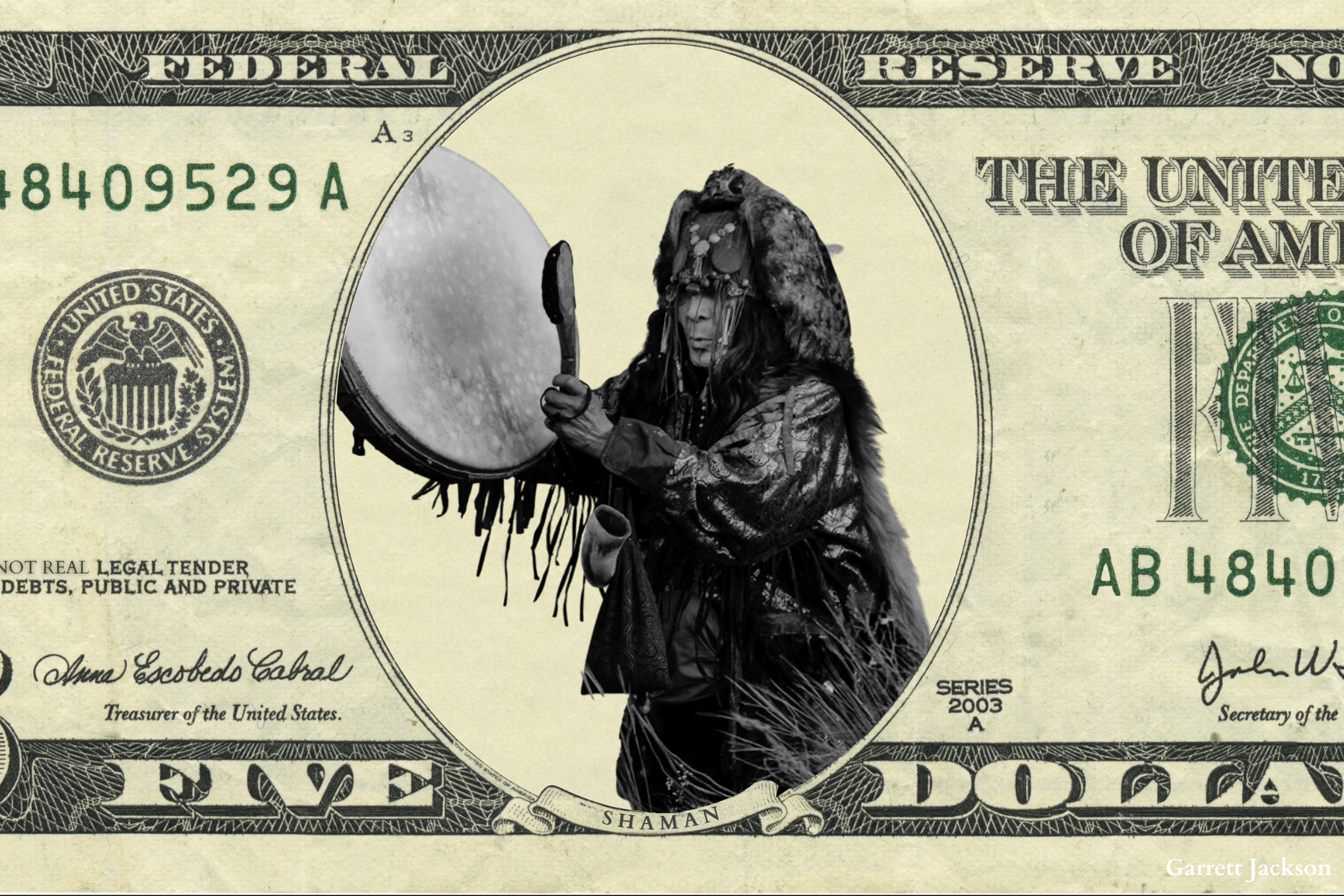
While this informant had a propensity for dramatics, they knew this shaman in question personally, and I would not be surprised if this was an accurate retelling. Maybe, too, I thought - not with malice, but as a matter of contrast - of the spate of healings I’d done in recent time for a perhaps more-economically-stable community abroad for around $30 each - minus PayPal transfer fees.
Shamans can approach compensation in different ways. And because, if we were to examine the compensatory practices of every class of psychic and medium, you and I would certainly be here long enough to die together, we will limit our examination generally to how some of those deemed shamans have been shown to “dance with dollars.”
It certainly is true that some shamans may be reciprocated in goods, such as a brick of tea and tobacco, for their services. As a girl, the shaman Yang Soon Im was carried by older shamans to other villages, and “paid in rice or sweets” for her fortune-telling. Mention of remittance may be absent from other accounts - payment would go against the “historical characteristic of Ju/’hoan healing” - whose healers journey, transfigure, and heal, and thus may be considered to be shamans - “namely that it should be made freely available to all who come to the healing dance” (though the authors added that 1989 saw “more discussion…about healers wanting to be paid for their efforts.”).
Before we stray too far into Pollyanna with the idea of cookies and tea for ceremonies, it ought to be noted that material goods can still generate opulence for the shaman. Stirling wrote that the “Jivaro” wishinu (shaman) is likely “the wealthiest man of his group,” due to his treatment fee scale, and that he may also generate income in exchange for sending sickness to another person (as one who studies shamans will see, the similarly Pollyannish notion that “all shamans are pure-hearted healers” has also been begging for a place in the trash bin). The difficulty involved in treatment could even see at least some wishinu receive the significant payment of a gun. A similar mode of payment has been recorded by Rasmussen - the shaman Aua, in exchange for words of magic hailing from the dawn of man, “provided [Qiqertáinaq, the elderly woman who shared the words with him] with food and clothing for the rest of her life.” Though it is unclear to me at present if Qiqertáinaq herself was a shaman, the price for magic words, Rasmussen writes, is one “which would soon ruin an expedition.” Here, too, it is stated that “[a] gun with an ample supply of ammunition was regarded, for instance, as a very natural price for a few…words.”
Sometimes, gift-giving has been noted to occur along with providing money. Hunzakuts bitans (who have been both deemed to be, and compared with, the shaman) have been described as occupying the “poorer half of the community”, and were reported by Csáji as operating on more “reciprocal gift-giving” (“gifts” here indeed including money, in more recent times) for shamanic work than payment proper, but noted that the bitans with whom he worked did set a fixed price for divination. Buyandelgeriyn similarly relays that, in Bayan-Uul, “[g]ifts to the spirits and shaman during rituals that do not include sheep sacrifice are minuscule (a prayer scarf, four yards of cloth, or cash to buy a loaf of bread)…attracting an audience that can provide sufficient gifts is tricky.”
Interestingly enough, Buyandelgeriyn also states how Buryat doubt could be found on either end of the shaman’s level of abundance, with overly-wealthy shamans fielding misgivings about their motivation, and poor ones judged as having ineffective spirits. Most Buryats were noted to believe that socialism had eliminated “real” shamans, and that the market economy’s shamans were money-driven. Znamenski wrote of the manner in which Soviet propagandists “picked up” the earlier pronouncement of missionaries who had claimed that shamans (their significant competitors) were “pathological deceivers” that “lived off their trade and exploited their patients.” Perhaps romantic Westerners have not been alone in their concerns about the shaman’s dollars.
Speaking of romantic idealists, in their literary search, interested persons among these may come across accounts that would make them shake their fists. Sang-Hun informs us of a shaman and her associates who, for five million won (then $5,400), promised to help their female client and her cheating husband reconcile rather than divorce. In “Korean Shamans and the Spirits of Capitalism”, Kendall shares the words of shaman Kim Pongsun as they reflected on the historical rarity of good-fortune ceremonies: “Who had money for that sort of thing? If someone was sick, then you would hold a healing ritual, or uhwan kut. Even if you went into debt for it, you had to do it. It was a matter of life and death.” Kendall also notes the “inflated costs of kut, now figured in millions of won (or thousands of U.S. dollars)”, and that in regards to urban Korean shamans, abundance is an “advertisement…of the efficacy of their spirits.” Nishimura, in her studies, reported that “older persons [seemingly in at least one part of Japan] may avoid relations with shamans because of bitter experiences with them in the past” - “heavy economic burdens” being cited as one of those reasons.
In her work on the Munda, Spencer relays the account of one boy, suffering from recurrent madness, who was arranged “to live as a servant in a shaman’s house so that he could receive treatment as occasion arose.” While I have nowhere near the ethnographic knowledge Spencer does in this regard, such an account begs the question - was the boy’s servitude a form of payment for services to be rendered? And would becoming a servant not be the ultimate form of “payment?”
Still other practitioners who are not, or at least may not always be called, shamans have been found to receive a fee; here, several examples will be noted from peoples associated with North America. Writing of the Plains Indigenous peoples, while acknowledging potential nuance, Powers and Martin say that “[t]he spiritual leader is usually paid for his services in food, money, or other necessities, although most indicate that payment is not required.” In “Navajo Use of Native Healers,” Kim and Kwok report that “the cost of visiting a native healer was reported to vary from $1 to $3000, with an average cost per visit of $388. The average annual cost of native healer use as a proportion of the patient’s self-reported income was 0.21, or roughly one fifth.” 36% of their given respondents noted that cost was the reason for not seeking more frequent Indigenous care, and mention is made of other customary expenses as transportation, feeding ceremony participants, and materials. The late Marcellus “Bear Heart” Williams, described as one of the last traditionally-trained medicine persons of the Muscogee Creek Nation (and whose work has had notable impact on me since the beginning of my journey), noted that, in the past and depending upon the situation, gifts offered to medicine people could include blankets, groceries, or even a team of horses. Today, however, “the gift is usually money” - the specific price, he did not set. While it is true that a non-Native individual may present a medicine person with tobacco, that is offered as a request for help - “it is not payment for services,” he said. “When patients give me payment, what they are doing is respecting my medicine ways, which came from above.” Without explicitly stating that it is necessary, he notes that those wishing to learn medicine ways present tobacco and money to their potential teacher as a symbol of respect, as well.
On the subject of training, Rasmussen wrote that young persons wishing to become shamans would present a valuable personal affect that “has cost the owner some trouble to obtain” to a teacher. Wood, he added, was “the most expensive of all” among the Iglulingmiut, “and it was therefore customary here to pay one’s instructor with a tent pole”. It was then presented as a gift to the student’s future helping spirits, but later could be used by the shaman himself. Navajo singers (trained specialists who perform ceremonies) “learn by apprenticeship, ratifying their knowledge by payment to the teacher,” Wyman notes, though what exactly constitutes “payment” here - goods or cash - is not clear to me. The prominent wishinu Tendetsa was required to pay an older shaman, Usatcho, “a high price” for what appears to be a one-month training, and gifted “food, ornaments, clothing, and other articles of considerable value.” Mircea Eliade, in his classic tome Shamanism: Archaic Techniques of Ecstasy, states that payment of a fee is made to a master by a “young Jivaro [who] decides to become a shaman,” and later goes so far as to say that, in South America, the shamans alone “can become rich, that is, accumulate knives, combs, hatchets, and other treasures.” In her aforementioned examination of the Munda, Spencer shares that tuition payments to a shaman “may or may not contribute significantly to his income.” While one Weaver individual was noted as having “arranged in advanced to receive from each of his pupils about two pounds of rice per week during [instruction],” she describes “much variation in this respect and some shamans are willing to teach for little or nothing.”
And certainly, variation has been found in this litany of illustrations, which should not all be immediately assumed to reflect current practice in the year 2026. Capping this particular collection on a perhaps somewhat humorous note, it could be instructive to note that even shamans will argue about payment. Karunovskaia, over a century prior to 2026, as reported in Shamanism in Siberia: Russian Records of Indigenous Spirituality, “vividly describes a fierce argument between an Altaian shamaness and her husband, who demanded his share of the fee for drying her drum for an arranged séance.”
Upon discovery of the above, one can draw a conclusion that A) shamans and other spiritual figures have indeed experienced reciprocity, in the form of both goods and money, and that B) the relationship between money and motivation could be a fascinating area of exploration. As in shamanic practice, one is trusted with their client’s greatest and most vulnerable hurts, and such a relational dynamic deserves the utmost integrity, I do not support the pursuit of a shamanic practice with the primary goal of climbing the tax bracket. However, we would perhaps betray our maturity if we concluded that financial or resource motive being an aspect of one’s psychic practice is itself immoral. Joralemon speaks to this issue, at the very least on the South American level, in his piece “The Selling of the Shaman and the Problem of Informant Legitimacy”:
“While some (e.g., Sal y Rosas 1965) define a charlatan in terms of pecuniary motive, I suspect one would be hard-pressed to find a modern shaman for whom earning a livelihood from his/her occupation is not a central concern. All of the seven curanderos with whom I have worked in Peru…are quite pragmatic about the business side of their practices. They seek to increase revenues by expanding their pool of patients…The sincerity of a shaman is not so easy to measure. As I argued above, a profit motive is hardly sufficient grounds to dismiss a practitioner as a charlatan.”
Joralemon further notes that, on multiple occasions, “Peruvian shaman informants welcomed [the possibility of new commercial opportunities] when I asked if they wished me to use their real names; one responded, ‘Of course, you are good publicity for me.’”
While it would be wonderful if the shaman, and human species more broadly, could evolve to a place of somehow no longer requiring resources, that is not the reality in which we find ourselves. And the shaman operates in both the spirit reality, and this ordinary one, which means that they can, so immorally and horrifyingly, “be concerned with the banal everyday world of putting food on the table, rental payments in the gaping maws of the rentier class, [financial resources] in their pockets, or nowadays in their virtual wallets.” In other words, shamans are people, too.
Although money can be burdened without nuance with the title “the root of all evils,” I contend that money can be a resource whose “goodness” or “evilness” is dependent, among other things, upon how it is used. Money can fund endless wars and needless suffering as it can the growth and joy of a child, the restoration of the environment from more immoral uses of money, and the ability of a shaman or other psychic practitioner to continue serving their communities with their craft, without becoming overly-unavailable by needing to pursue other means of making ends meet. Aiding the continuity and growth of sacred work that is close to our hearts, and important to the planet, by supporting its practitioners is perhaps one of the most “good” uses of one’s cash that I can think of.
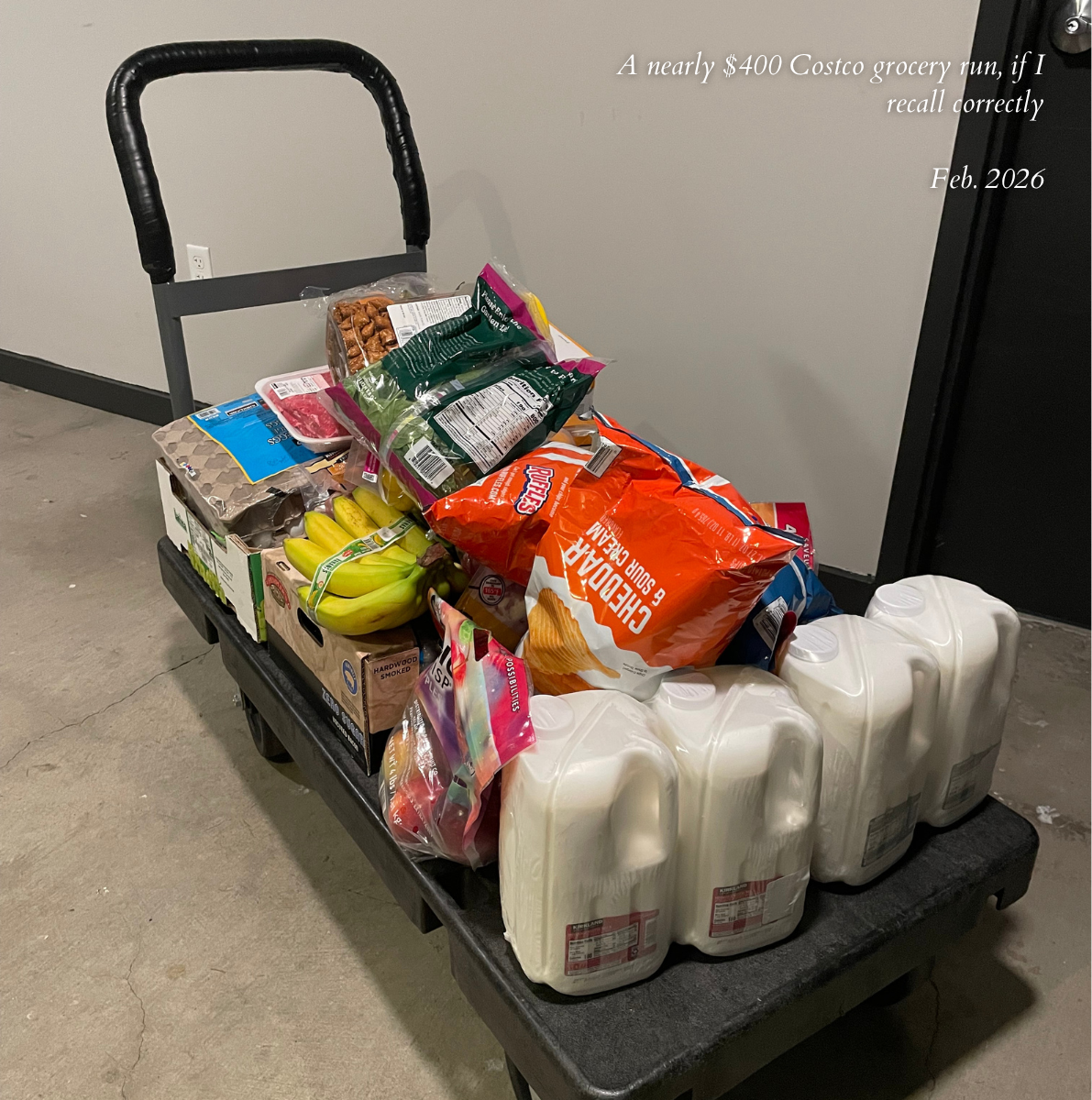
Having said that, if persons wish to purchase services or spots in training programs with me through goods of value (such as groceries, food for my six-month-old cat, gas for transportation, and so on) as opposed to money, I would welcome this with open arms! However, at least in the United States, these things usually involve spending money regardless, and indeed, one may find that my services and workshops are often priced below what a single grocery trip for two people costs at the moment.
Dancing with Money: Several Recommendations for Ethical Economics in Psychic Practice
There are, as illustrated above, a number of compensatory possibilities that can unfold or be integrated into one’s shamanic or psychic practice.
As has already become clear, I do not take the position that asking for or accepting money specifically in exchange for spiritual work is immoral or necessarily “out of step” with the tenderness of the work itself. Whether it is groceries, guns, or cold hard cash, I treat compensatory value as, at least in one way, being in the eye of the recipient (the shaman or psychic). Thus, cosmically, I cannot say that money is necessarily required to be exchanged in one’s practice. However, if one wishes to have money exchanged to support their practice and lives, what follows is a non-exhaustive list of several recommendations for “dancing well with money,” as certainly, unethical economic practice can (rightfully) earn one a poor reputation - and even reflect poorly on the practitioner’s profession at large.
An important caveat: I am not a (financially) wealthy man. As noted elsewhere, I am a Medicaid recipient, as my practice and life in their current iterations do not generate anywhere near what would be considered a comfortable income for myself nor my family, despite my approximately decade-long efforts and the meaningful nature of the work that I engage. The potential factors contributing to this - including my age, race, high mobility contributing to lack of savings and ability to establish a presence in one area, and the appreciable absence of a fame that sees googly-eyed publishing companies and organizations trip over one another to plaster my face across the globe and make money off of my name - are beyond the scope of evaluation here. Thus, what follows is not a “get rich” schematic for one’s shamanism or other mediumistic practice; merely suggestions that one can reflect on and potentially utilize for a more harmonious relationship with money as a practitioner of the psychic arts. Such suggestions can also be recalled by patrons of these arts in informing a decision about the ethics of a given practitioner:
Check (or Recalibrate) Your Moral Compass: As mentioned prior, not charging money for spiritual services is an entirely valid way to conduct one’s practice. Giving goods, service trades, and even making donations to a charity of the practitioner’s choice are alternative options here - this or pro-bono works well when one is just starting to get their “sea legs” working with others and seeing if their work generates good results. Not charging money due to one’s own romanticism that “shamans shouldn’t charge” or unaddressed personal discomforts in your relationship with money, however, is not.
Whether you practice shamanism or another psychic form in which you have a demonstrated record of accessing accurate information, it may be worthwhile to examine this relationship with your own trusted helping spirits. They can help to bring you to a good place regarding money - and that doesn’t necessarily mean they’ll ask you to charge for your work, either. As a teacher of shamanic direct revelation, my highest wisdom to offer students will always be: “Talk with the spirits on it.” Ways to frame your question to them can include, “What is your perspective on my charging money at this time in exchange for the shamanic sessions that we provide for others?” or “How do you recommend I make an abundance of money off of our spiritual work together, if at all, at this time, while keeping myself healthy and fulfilled?” Interestingly, Eliade penned that, for the North American shaman, “the determination of his fee [itself has] a ritual character. If the shaman asks too high a price, or if he asks nothing, he falls ill. In any case, it is not he but his ‘power’ that determines the fee for the cure. Only members of his own family are entitled to gratuitous treatment” (by “power,” I would say that Eliade is referring here to the shaman’s spirit helper/s).
In the same vein, be honest with yourself if you discover that your compass is primarily pointed to the goal of financial gain. We are all human, and certainly, money can be a motivating factor in your work. But going into practice and holding people’s hearts in your hands purely or primarily for that reason deserves appropriate reflection and caution (especially when made aware that spiritual work does not always generate a sizable income stream to begin with).
Recognize the Reality of Credit: No, not that kind of credit. Some practitioners of psychic arts may be concerned that accepting money for services is taking credit for the work of Spirit. After all, if the shaman’s main role is to become a “hollow bone” for the powers of the universe to work through, why would we as practitioners be paid?
In my eyes, paying for such services is not glorifying the practitioner or compensating them for Spirit’s work; it is compensating them for their time (which is finite and valuable), their training (training with teachers can cost money - sometimes a pretty penny), and all that they may have sacrificed - and continue to - to be here, with you, now. We can honor the spirits, and help the shaman keep their doors open, at the same time.
Find Your “Right (for now) Price”…: During my studies with the truly radiant Charles Virtue, I recall having been taught that the “industry standard” for psychic readings was no less than $1 USD per minute. When I checked in with him recently on this, he replied that “believe it or not,” he stands by $1 per minute for newer mediums. This, he said, is a “solid starting point,” as $15 for a 15-minute reading, for example, is a low-pressure, low-price balance until a reader can “find their footing” (and of course, he noted, “a LOT of information can be channeled in 15 minutes”). “As experience and confidence grow,” he added, “most readers find a niche - or a passion about a specific type of reading or healing offering.” Upon specialization, he continued, the market rate is something that has to be explored. Virtue elaborated that most readers will find that a “divine number” will simply come to them, like $111 or 222 for a life purpose reading, for example. “Once that point is reached,” he says, “it’s less about the duration of the reading and more about the content value.”
The “industry standard” concept has provided me with a useful tool for pricing my own services. If one is offering in-person services specifically, they may also choose to examine what other similar practitioners are charging in the region, to gather a potential idea of what “the community can handle.”
When it comes to teaching offerings like workshops, the same local-look principle can be applied. In regards to online teaching specifically, in introducing its online shamanic healing training program during the COVID-19 pandemic, the president of the late and controversial figure Michael Harner’s foundation reported that, while their faculty members are independent contractors who may have various expenses to address, the workshops ran “somewhere around $20 an hour.” $20 an hour is also what Virtue, in my teacher training with him, recommended for video classes, along with noting that more may be needed to cover travel expenses and other factors.
…But Don’t Get Stuck There: As personal needs and the economy (either global, national, or local) change, you may also find a need to raise or decrease your prices. Similarly, you may find clients who, for whatever reason, need flexibility in your rates. In some cases, I may not charge clients anything at all, instead asking that they save or re-direct what money they have in order to cultivate a better life. In a recent case, I even asked Alexi - who has seen success in persons obtaining employment after doing so - to rework the résumé of a shamanic healing client who had been staying in a shelter, which he happily did free of charge.
Sliding scale, case-by-case discounts, the creation of a scholarship fund for workshop students in need, the informal (or even formal) establishment of a local network of other trusted practitioners who are similarly flexible in their pricing that you can refer out to when your financial or emotional “budget” for low-cost services is temporarily depleted, and so on are appropriate means for addressing the diverse needs of the people. You can charge rates, but spiritual work is best when it is accessible. Have a structure, but don’t make it scripture.

Note the Potential Healing of Payment: The American Psychological Association, in defining “price-quality relationship,” states that, generally, “consumers think that higher prices mean higher quality.” Now, this does not give one an automatic academic license to charge, say, $500 for a one-hour reading or $10,000 per shamanic healing session. It does, however, challenge us to recall the moments that we’ve seen an item or service priced below what we would expect, and as we turn the other way, wonder to ourselves, “What’s the catch?”
Beyond charging a reasonable fee being a credibility-builder between you and the public, paying itself might have “healing properties.” By spending one’s hard-earned resources to fund a healing, the client may be more motivated to act on the action steps given by their practitioner to further their recovery, for example - with a sacrifice of money, they now have “skin in the game.” Such a concept may have been reported among the Navajo by Wyman (with emphasis included by me); “[t]he singer is paid according to the elaborateness of the ceremonial, and by reciprocity he is compelled to perform if he accepts the fee. Conversely, it is the payment which insures the efficacy of the performance. The cost of a ceremonial may vary from the equivalent of 25 dollars for a two-night performance to several thousand dollars for a nine-night chant when hundreds of spectators must be hospitably fed by the sponsors - the patient and his kinsmen.” Winstanley-Chesters writes of how “[t]he discomfort [present in the complicated negotiations over cost and expense among those concerned] is one of the really valuable elements of the entire process, as in the expense essentially really has to hurt to remind everyone of the real power and worth of the ritual, even though to all involved that expense is not entirely welcome.” Sacrifice can create a sense of value and commitment to regard the work with appropriate import, even after the spirits who did the work have been sent home.
“Smaller” Scale Doesn’t Mean Small Impact: When I first began psychic work, my teacher (whom I next to idolized) was a rather high-earning woman who had been in the field for around 25 years, with high means of visibility and a swath of published books and oracular card decks. I recall believing that, as soon as I opened my doors, I, too, would be flush with interest - and the relative shock that came when that, of course, didn’t happen.
In addition to the literary examples provided above (though there can of course be nuances to the financial state of each of the peoples involved that are worth considering in this regard), Buyandelgeriyn wrote that, “[a]t least in Bayan-Uul, without other resources, most shamans cannot support themselves or a family through ritual practice alone…Successful shamans are usually men who had a good economic basis, with a home, a family to support, and a decent-sized herd of livestock, prior to initiation.” “The Hunzakuts shamans maintain other occupations such as farming and animal husbandry, so we call them ‘part-time specialists.’ No one can earn a living from the shaman’s activity”, says Csáji. Spencer, again in her Munda study, noted that “it may be years before [the newly-initiated shaman] builds up a reputation of the sort to attract clients in any number and from distant places.” And while wealth appears a “lure” for some, this is, in a general sense, “probably not very realistic”; she follows this by stating that the shaman’s work “is a part-time job, and the returns are at best uncertain.” While an established shaman could measurably add to their income through their work (she recounts the story of one shaman was able to earn “much money” after his initiation), Spencer includes that fathers are even known to point out the poverty of shamans to their sons in an effort to dissuade them from pursuing shamanic training.
Certainly, these examples do not dictate that shamans in different cultures (including my own) cannot, or do not, practice full-time. Yet, if your economic position is one in which you aim to use your practice to make ends meet, this may meaningfully color your passion with pressure. Multiple workshop venues that I have taught in over time have shuttered their doors, including one run by perhaps one of the wealthiest people that I have ever met (in their case, I recall the upkeep expenses outpaced shop revenue). Conducting spiritual work on “opening the gates” of financial well-being or abundance to flow through (or in to support) your work is a worthwhile subject to speak with the spirits on, as could be the examination of the business models of those who have made their work “work” full-time (and do so ethically). And on a lightly crass but seemingly-true note, marrying into well-off-enough wealth seems to be an effective method for supporting one’s passions!
Ultimately, recognize that you do not have to be full-time, the next “big thing,” the author propped up as a guru or saint among men in order to do this work and fulfill a calling, nor need you live out the romantic, expletive-laced quitting of your day job in order to devote your attention solely to other soul pursuits. Each individual’s path may look a bit different. While the details of your own calling are worth investigating with your spirits, it is vital to remember that part-time or “smaller” scale than a 9-5 professional spiritual practice does not mean “small impact.”
──────────
Cheung is not only a presence when it rains; as NBC is kept streaming softly on that small television throughout the workweek, I see much of him, and even more of Zinhle Essamuah, Kristen Welker, and Tom Llamas later on. And in watching perhaps most major news rotations, one can certainly get the distinct impression that things in our nation, and variously abroad, are not always going so well.
But there are bright places, too. Even in real-world journalism, lightening jokes are cracked, and heart-repairing footage is shared of mushy couples lovingly celebrating their umpteenth wedding anniversary. A warm story about a child pursuing their dreams despite the odds, or a local beat cop performing life-saving CPR on an infant, or the occasional refreshing check on United States presidential power - there is still much to smile about in our everyday lives, and in our world at large.
Perhaps the same could be said of money. There are innumerable ugly uses of financial wealth that stare us boldly in the face each day, clearly as well as slyly from behind a mask - yet there are also brilliant small-scale and big-picture uses of dollars and cents. The shaman’s dance with said dollars has its own duality; rejecting money out of discomfort or charging beyond the people’s means seems out of alignment with harmony - a discordant dance - whereas a dance that benefits shaman and community both can be had through ethical integration of economics into their practice. Perhaps, too, it is time that we re-evaluate the narrative that it is the money that is evil - it could be said, after all, to be only a neutral means to an end - and consider where the “evil” may actually lie: in the divisive sense of need, or greed, or the natural unconscious orientation towards survival stuck in hyperdrive, that occasionally grips the throat of the human experience. Currency can fund this, and it can fund “the light” of psychic and shamanic work that offers inspiration where there was hopelessness; recovery where there was a shattering; and direction when even the faintest of guiding stars leave our sky.
And if money truly is the wicked force that some would posit it to be, I must wonder about the nature of my helping spirits’ relations to it. Beyond providing me with ethical financial advice as it pertains to our shamanic work together (advice which has been included in the prior recommendations), I will share here an account of a psychic reading that I did for a client, in which my incredible divinatory ally, Archangel Haniel, showed me money pots to indicate that financial abundance was coming the client’s way. The client later reported that she opened her wallet to find a $100 bill, despite the fact that no one had given her one, and that she had not visited an ATM in months. Perhaps the spirits, like humans do, can work within the imperfect paradigm of economics that they have been presented with, and still find a way to give us miracles.
© Garrett Jackson, 2026